Know where to sell next.
Elevare connects what your company already knows with what is changing in the market, so your sellers know which accounts, projects, and territories deserve attention now. Not more names. The reason an account is worth a call this week.
Your sellers start the day with a blank CRM and a territory map.
So opportunity gets discovered late. The facility was announced in March. The new operations leader started in April. The RFP posted in May. The rep found out in July, from a competitor's truck in the parking lot.
What your company knows, joined to what the market is telling you.
What you know. What happened before. Who you know. What you've sold, at what margin, and how the relationship actually went. It lives in the CRM, the inbox, the proposals folder, and the people who were there.
What changed. Who is growing, hiring, building, buying, or moving. Which projects are forming, which leaders arrived, which permits and bonds and RFPs were filed. It lives in public sources, government filings, procurement portals, job boards, company sites, and market data.
Territory Intelligence, what this page describes, is usually the first thing most companies put the intelligence layer to work on. This is the outside half. It is worth most when it sits next to the inside half: what your company already knows about those accounts. See Company Intelligence → The system should be able to say: we decided this last quarter for these reasons; three things have changed since, here is the source for each, here is what it invalidates, here is the confidence, and here is who should approve the next move.
“What should I focus on today?”
One screen, first thing in the morning. The accounts and projects in your territory that changed, why they matter, who to contact, and what to do about it. The CRM history is already attached.
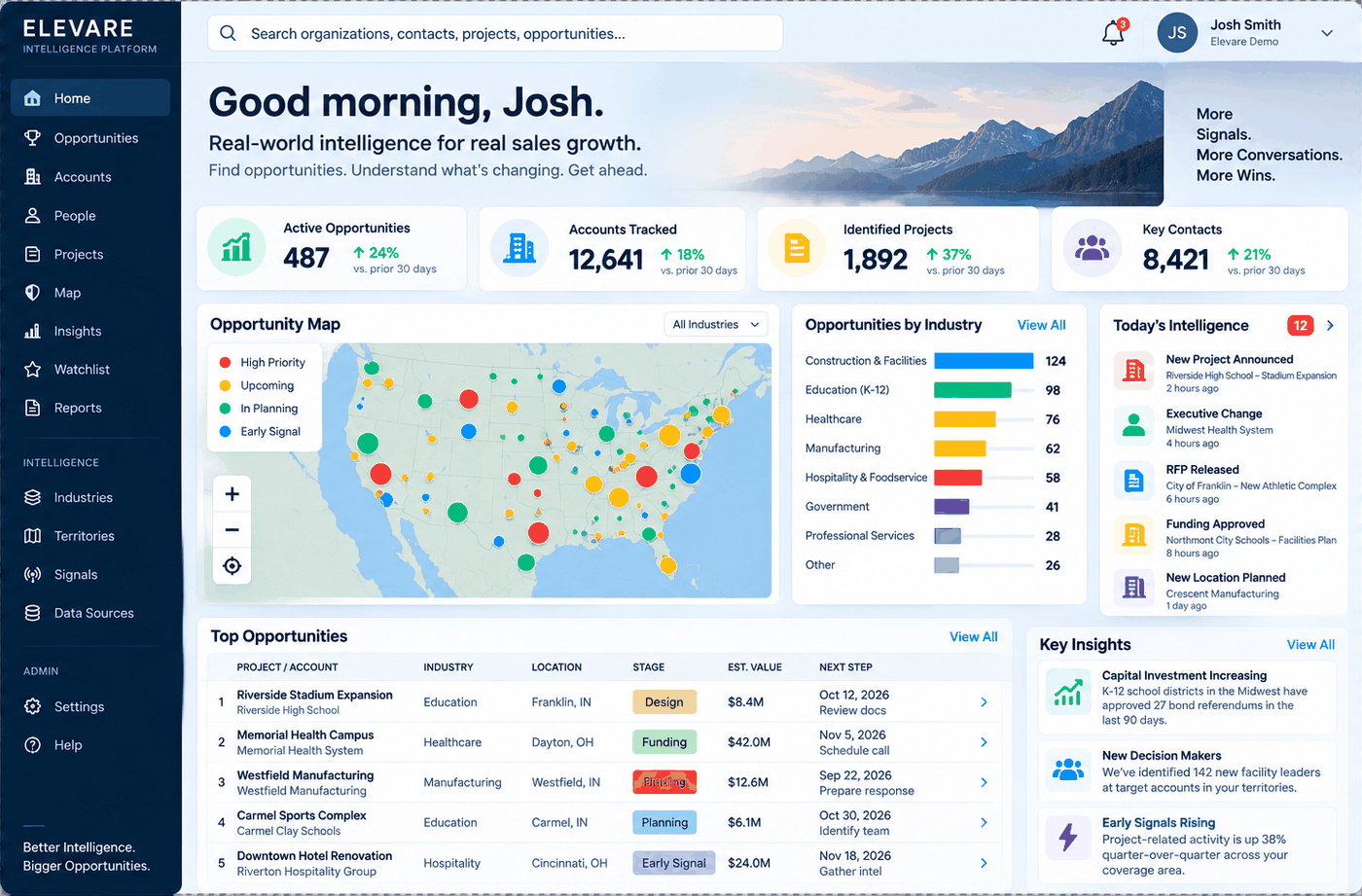
- Who should we pursue. Accounts and projects ranked by fit and by what just changed, not by alphabetical order in a list.
- What changed. A new facility, a leadership change, a hiring surge, an approved bond, a posted RFP, an acquisition. Tracked continuously, not discovered by accident.
- Why it matters. Every signal carries its reasoning: what it is, where it came from, and why it makes this account worth attention now.
- When to act. Buying windows, project stages, renewal dates, and the point where influence is still possible.
- Who to contact. The decision makers and influencers at the account, including the ones who arrived last quarter, with what your company already knows about them.
- What to do next. A next action, with the account brief and the CRM history behind it, so the rep walks in already knowing.
Build the market once. Keep it current forever.
Build the market.
Define the territories, segments, and the kinds of organizations, facilities, and projects your team sells to. That becomes a living map, not a one-time list.
Track change.
Public sources, government filings, procurement portals, job postings, company sites, and market data are watched continuously and matched to the right organization, even when the name on the filing doesn't match the name in your CRM.
Interpret signals.
Not every change matters. The platform learns which events in your market predict a buying decision, and why.
Prioritize opportunity.
Accounts, projects, and territories are scored on fit, timing, and what your company already knows, so the top of the list is worth the rep's morning.
Deliver next actions.
Briefs, decision makers, and a recommended next step, delivered where the rep works, with the reasoning attached.
Learn from outcomes.
What converted, what didn't, and why feed back into the scoring. The second year of the platform is sharper than the first.
Built for teams that sell into a territory, a project, or an account.
Field and territory sales.
Territory prioritization on a map. Less windshield time chasing accounts that haven't changed. Local opportunity surfaced the week it forms, routed to the rep who owns it.
Project-driven sales.
Project detection from the earliest public trace: funding, bonds, architect and GC selection, procurement, buying stage. The window where influence is still possible, flagged before the RFP.
Account-based sales.
Company change at the accounts you already own or want: leadership, hiring, expansion, acquisition, compliance events. Joined to the incumbent relationship and the CRM history so the outreach is informed, not cold.
The signals change by industry. The platform doesn't.
“Where is my team missing opportunity?”
Territory coverage and whitespace. High-priority accounts nobody is working. Emerging opportunity by region. The pipeline laid over the market, so the gap between the two is visible.
Where the market is moving. Geographic concentration, major projects forming, segments emerging, and territory performance against the opportunity that was actually there.
What this is not.
- Not an SDR bot. Nothing writes to your prospects or sends on your behalf.
- Not email automation. This is intelligence for the seller, not volume aimed at the buyer.
- Not a purchased lead list. Lists are names. This is the reason an account matters now.
- Not another CRM to maintain. It feeds the one you have and reads from it.
- Not a generic AI assistant sitting beside your systems. It's built around your market and your history, and it remembers.
Assess the market. Pilot one territory. Then expand.
Sales Intelligence Assessment.
The revenue-scoped Assessment, with the market defined: your ideal customer, your territories and segments, the signals that predict a buying decision in your market, the internal data worth joining, and the external sources worth watching. You get a written, ranked plan and a first-territory recommendation.
Fixed scope, priced before we begin. Starts at $5,000.
Sales Intelligence Pilot.
One territory, region, or segment. We build the target universe, wire the signals, set up scoring, stand up the rep view, and deliver the first intelligence. Your team works it for a defined period, and we measure what it surfaced against what they would have found alone.
Fixed scope, quoted from the Assessment.
Full Platform.
More territories and reps, CRM integration, manager and leadership views, continuous refresh, and broader intelligence as the market changes. Reviewed quarterly. Cancelable.
Quoted, never listed.
One platform. Sales intelligence is the first thing it's pointed at.
Written on sales and territory intelligence.
What people ask about the Sales Intelligence Platform.
What is sales territory intelligence?
How is this different from buying a lead list or contact data?
Does it replace our CRM?
What does a rep actually see each morning?
How do you know which signals matter for our market?
Can this work for project-based sales?
Find out what your market is already telling you.
The Sales Intelligence Assessment defines your market, your signals, and your first territory. Fixed scope, priced before we begin.