Elevare Command.
The intelligence layer we run ourselves. It is how we see, and the reason a recommendation arrives already reasoned, already ranked, and signed by a person.
Elevare runs on the same three parts we build for clients, on our own company.
One boundary matters here: a client's intelligence layer is built for the client's business, on the client's accounts. It never runs on Elevare's data, and Elevare's Command never runs on a client's.
Our own map, and what we get wrong.
An intelligence layer, not an inbox of tickets.
What it can see changes depending on where we are in the relationship. That distinction matters, so we state it plainly rather than implying more than is true.
Before we work together
Command reads what is observable from outside: your digital presence, market signals, and how the business is positioned to adopt technology. It is enough to arrive at the first conversation with a hypothesis instead of a questionnaire — and honest enough to admit that a hypothesis is all it is.
Once we're inside
Command reads far more: revenue systems, operations, customer signals, your documentation, and the history of what has already been tried and why. And it remembers — decisions, context, results. That memory is why the advice sharpens every quarter instead of resetting with every project.
How a recommendation gets made.
The whole model on one page: what Command can read, what it does with it, the standard the output is written to, and the person who signs it before it reaches you.
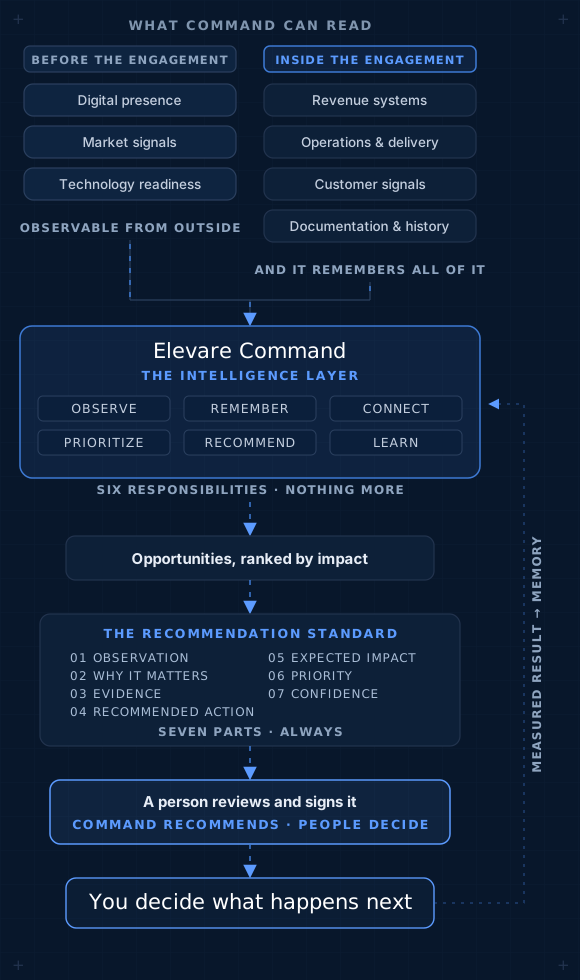
Everything below this diagram is detail. If you only read one thing on this page, read this.
What Command is — and what it isn't.
Command is
- A continuous reading of the whole business, once we are inside it
- An engine that detects and ranks growth opportunities
- The reason our recommendations are proactive
- Our competitive advantage as a firm
- Intelligence that compounds the longer we work together
Command is not
- A product you buy or a seat you license
- A dashboard you're asked to log into and manage
- Another tool added to your stack
- AI for its own sake
- Something we use to sell you more services
Six responsibilities. Nothing more, nothing less.
The six chips in the middle of that diagram are the only things Command is responsible for. Anything outside this list is scope creep, and we treat it as such. Here is what each one actually means.
Notice what people miss.
It watches the business continuously for new signals, risks, and patterns. Observation is passive by design — it creates awareness, not work.
Hold what the business forgets.
People forget. Organizations drift. Knowledge walks out the door. Command keeps the decisions, the context, the lessons, and the reasons — so nothing important depends on one person's memory.
Find what sits between systems.
Most opportunities aren't inside marketing or sales or operations. They're in the gaps between them. The value is usually in the relationship, not the individual fact.
Reduce noise, not add to it.
Everything gets ranked by business impact. If everything is important, nothing is — so Command's job is to tell you what to ignore as much as what to act on.
Never without reasoning.
Every recommendation carries all seven parts — what we observed, why it matters, the evidence, the recommended action, the expected impact, the priority, and the confidence. A recommendation without reasoning is an opinion. We deliver judgment.
Improve from what actually happened.
Results feed back in. Recommendations that worked strengthen future judgment; ones that didn't get reviewed and captured. Learning is evidence-based and traceable, or it isn't learning.
Command runs on the Operating Layer. It is not the Operating Layer. See the architecture →
What a recommendation from us looks like.
One standard governs every recommendation Elevare makes — in a proposal, in a Growth Note, in a meeting, or from Command. Seven parts, always. If a recommendation can't carry all seven, it isn't ready to give you.
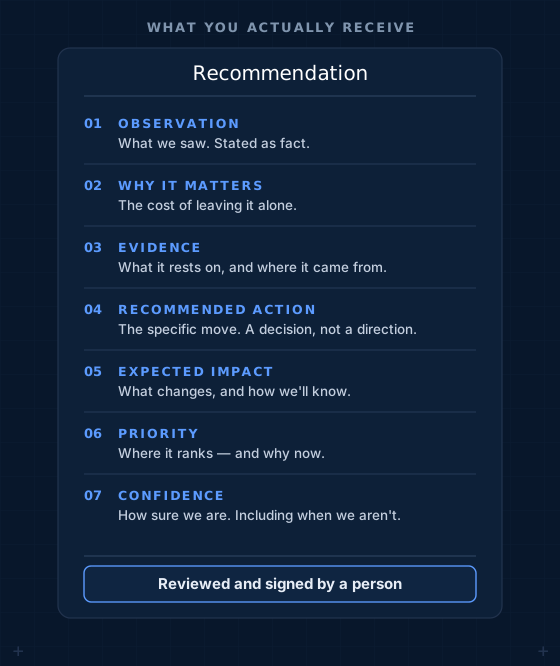
If a recommendation can't carry all seven, it isn't ready to give you — and a person's name goes on it before it reaches you.
A representative recommendation for a mid-market manufacturer, written exactly as it would be delivered. Deliberately not a marketing or website recommendation — this is what an Intelligence constraint looks like.
The business reports revenue by product line and gross margin at the company level. It cannot report margin by customer segment. Sales incentives are paid on revenue, and the fastest-growing segment is also the most heavily discounted one.
Growth is currently being bought rather than earned. Every incremental dollar of demand is routed toward the segment that returns the least, and because nobody can see it, the pattern strengthens each quarter. This constrains the business more than any lead-generation gap, and no amount of marketing corrects it.
Two years of invoice-level data joined to the customer master; realized price against list by segment; the commission plan; and the observation that no existing report in the business joins margin to customer type. The absence of the report is itself the finding.
Build one segment-margin view from data the business already has, reviewed monthly. Then make one decision with it before changing anything else: which segment gets the next increment of sales capacity. Do not restructure the commission plan yet — a plan changed before the data is trusted gets reversed.
Improved gross margin at flat revenue within two quarters, from reallocation rather than price increases. The durable gain is decision quality: the business gains a number it can steer by, which changes every subsequent capacity and pricing decision.
First, and it should precede any growth spend. Every quarter it waits, more capacity commits to the wrong segment and becomes harder to move. It is also cheap and reversible, which is rare for a change this consequential.
High on the diagnosis. Low on the size of the gain until the data is built. That the business cannot see segment margin is a fact, not an interpretation. How much margin is actually being lost is unknown until the view exists — which is precisely why the first recommendation is to build the view, not to act on an assumed number.
This is the shape of every recommendation we make. Judge it before you hire us.
The Recommendation Standard in full — all seven parts explained →
Command recommends. People decide.
Intelligence improves judgment. It does not replace responsibility, and it never carries the relationship.
Vision, relationships, ethics, and final decisions stay with humans. That boundary is written into how we operate, not decided case by case. If Command cannot explain a recommendation, it does not make one.
Why it compounds.
A vendor relationship restarts at zero every project. This one doesn't — and that difference is the entire commercial argument for a partner over a supplier.
It gets smarter the longer we work together.
Every result feeds back into the intelligence — what worked, what didn't, and why. The Flywheel turns, and the next diagnosis starts from a sharper picture than the last one did. The second year of a relationship is worth more than the first because the intelligence behind it is.
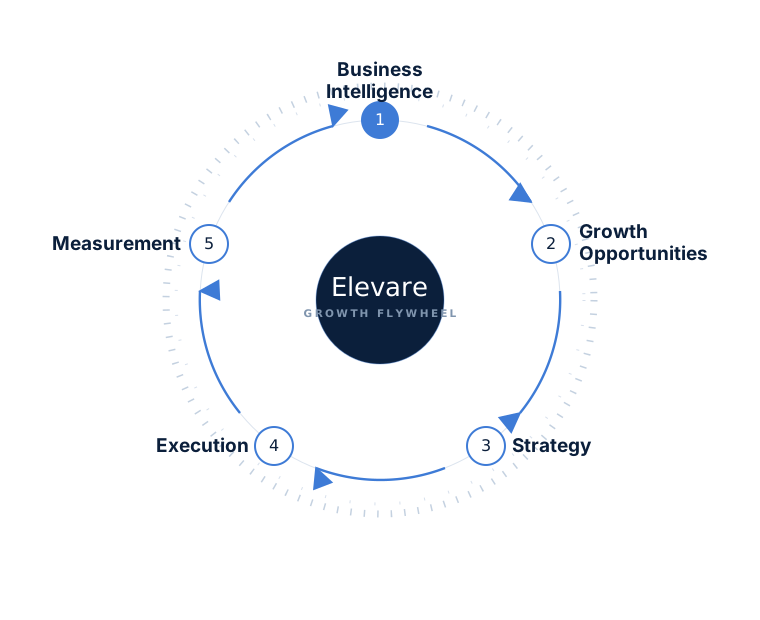
Command discovers. Elevare interprets and executes. You experience continuous improvement.
That's the whole model. Command is not the product and never will be. It is the reason a partnership with Elevare is different from hiring another vendor — and the reason a recommendation reaches you already reasoned, already ranked, and signed by a person who is accountable for it.
What people ask about Command.
Is Elevare Command a software product I can buy?
What does Elevare Command analyze?
Does a human review Elevare Command's recommendations?
See the same layer built for your company.
A written, ranked read of what your company knows, where it lives, and what to build first.