Why Most Websites Don't Generate Revenue
Most business websites don't generate revenue because they're built as brochures, not as systems. A brochure describes the company. A revenue system captures intent, earns trust fast, and routes every interested visitor to a next step someone actually follows up on. Fix those three jobs — capture, trust, follow-through — and the same traffic starts producing pipeline.
Ask most companies what their website is for and you'll get a version of the same answer: it's where people learn about us. That answer is the problem. A site built to describe the company is a brochure with a hosting bill. It can be beautiful, current, and completely disconnected from revenue. The visitors show up, read a little, and leave — and nobody can tell you what happened to them.
Growth is a system, not a collection of assets. Every part of the business either moves a customer toward a purchase or quietly lets them slip away. A website sits at the front of that system, which makes it one of the few points where a change moves everything downstream. When it's built as a brochure, it isn't neutral. It's a leak — and leaks at the top of the system cost the most, because everything downstream depends on what gets through.
The brochure trap
The brochure site is the default because it's the easiest thing to agree on. Everyone in the building has an opinion about how the company should look, so the site becomes a consensus artifact: the right logo, the polished photography, the tour of what you do. None of that is wrong. It's just aimed at the wrong target. A brochure answers "who are you." A buyer showing up with a problem is asking something else entirely: "can you solve this, and what do I do next."
The tell is what happens after someone is interested. On a brochure site, an interested visitor has nowhere to go. They read the services page, nod, and close the tab. There's no obvious next step, or the only one is a generic contact form that lands in an inbox nobody watches. The company spent real money getting that person to the site and then let them leave without a trace. That's not a design failure. It's a system failure.
The three jobs of a revenue system
A site that generates revenue does three jobs. Miss any one of them and the other two stop mattering.
1. Get found — capture intent
Revenue starts with intent. Someone has a problem and goes looking. If your site isn't in front of them at that moment — in search, in the map pack, on the page they actually land on — the rest of the machine never gets to run. Getting found isn't a vanity exercise in traffic. It's about being present for the specific searches that signal a buyer, and landing them on a page built to answer the question they arrived with, not your homepage.
2. Build trust fast — credibility in seconds
A visitor decides whether to keep reading in the first few seconds, and they decide it before they've read a word of your copy. Clarity, proof, and a sense that you understand their situation do the work. Most brochure sites bury this. They open with a mission statement instead of the problem the visitor came to solve. Trust is earned by being immediately relevant: name the problem, show you've solved it before, make the path forward obvious. Credibility is not a page on the site. It's the first impression the whole site makes.
3. Route to a followed-up next step
The third job is the one that's almost always broken. An interested visitor needs a clear, low-friction way to act, and that action needs to reach a person who responds. Not a form that fills a database. A next step someone owns. A quote request that gets answered same-day beats a slick site that answers in four. The website's job ends at capture. What happens in the next hour decides whether the capture was worth anything.
Where the constraint actually sits
This is where most of the revenue actually disappears, and it's why a better website alone rarely fixes the problem. You can nail the first two jobs — get found, build trust — and still generate nothing, because the lead the site captured lands somewhere it dies. A form submission nobody routes. A quote request that waits three days. A phone number that goes to voicemail during business hours. The site did its part. The system behind it didn't.
This is what we mean when we say growth is constrained rather than missing. Elevare diagnoses against six lenses — market, revenue, operations, technology, intelligence, and leadership — and the website sits in technology while the failure here almost always sits in revenue. The page is not the constraint. The handoff is: the space between "someone raised their hand" and "someone followed up." Rebuild the site without fixing the handoff and all you have done is leak faster. See the six lenses →
A website doesn't generate revenue. A system does. The website is where that system starts, or where it quietly fails.
Is your site a brochure or a system?
You can usually tell in a few minutes. Run through this honestly:
- When someone is ready to act, is the next step obvious on every page — or do they have to hunt for it?
- Does a form submission or quote request reach a specific person who owns the response, or an inbox nobody watches?
- Can you say what happens in the hour after a lead comes in — or does it depend on who notices?
- Do your top landing pages answer the question a buyer arrived with, or do they describe your company?
- Do you know how many visitors turn into conversations, or only how many visitors you get?
If the answers lean toward "hunt," "inbox," and "depends," the constraint is not your traffic. It is the system your traffic feeds.
The recommendation this produces
Every recommendation Elevare makes carries the same seven parts, whether it comes from a proposal, a Growth Note, or Command. Here is what this article's finding looks like written to that standard — so you can judge the reasoning rather than take the argument on faith.
Inquiries arrive through a form, a general inbox, and a phone line. None of the three has an assigned owner, a target response time, or a record of what happened after arrival.
This is demand the business has already paid to create. A redesign increases the volume arriving into the same unowned handoff, which increases the loss rather than the revenue.
Where inquiries land and who currently touches them; time from arrival to first human reply across a recent sample; the count of inquiries with no recorded response at all.
Route every inbound channel to one owner with a defined first-response window. Log every inquiry and its response time. Do this on the tools already in place, and do it before any design work begins.
More of the same traffic converting into conversations, measured on one number: percentage of inquiries receiving a human reply inside the response window.
First — ahead of the redesign. Fixing capture before improving capture is the cheaper order, and it makes the redesign measurable when it does happen.
High on the diagnosis. Moderate on the gain. Whether an inquiry is owned is directly observable. How much revenue was recoverable depends on how many of those inquiries were real buyers, which is unknown until the logging exists.
The website is a stage, not the answer
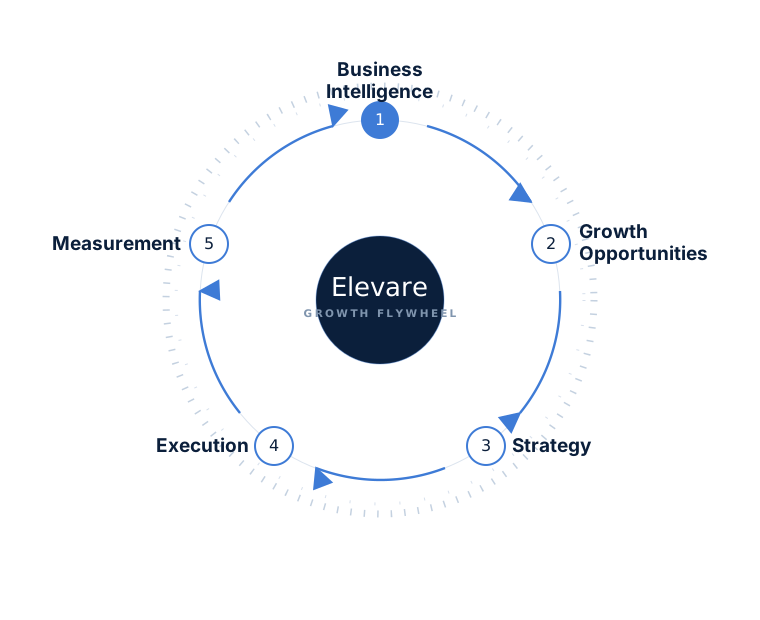
Here's the reframe worth holding onto. The website isn't the problem, and it isn't the solution. It's one stage in the Growth Flywheel — the point where intent gets captured and passed to everything downstream. Treat it as a standalone asset and you'll keep redesigning a brochure. Treat it as the front of a system, wired to the response behind it, and the same traffic you already have starts producing pipeline. Nothing about the visitors changed. What changed is that the business finally does something with them.