How Manufacturing Companies Lose Leads
Most manufacturers don't lose leads to a competitor. They lose them to their own follow-up. A qualified RFQ comes in, lands in a shared inbox or on an estimator's desk, and sits — while the buyer, who contacted three suppliers the same afternoon, moves on with whoever answered first. The lead was never won or lost on price or capability. It was lost to a slow, manual, unowned process. Fix who owns the response and how fast it happens, and the same inbound starts closing.
Ask a manufacturer where their leads come from and you'll hear about referrals, repeat customers, a few trade relationships, and a steady trickle of inbound quote requests. Ask where their leads go and the room gets quiet. Most established manufacturers have more demand arriving than they realize. What they don't have is a system that catches it. The leads aren't missing. They're leaking.
This matters because manufacturing demand is high-intent by nature. Nobody fills out an RFQ or calls for a quote to browse. They have a part, a project, a spec, and a deadline. That's a buyer with their hand up. When one of those goes unanswered, you didn't lose a lead — you lost an order that was ready to happen.
The leak isn't at the top. It's in the middle.
The instinct, when growth stalls, is to go get more leads: more marketing, more trade shows, a new website. Sometimes that's right. Usually it's premature. Most manufacturers are already generating more qualified interest than they convert, and pouring more in just means leaking more. The expensive gap is rarely awareness. It's the middle of the funnel — the stretch between "a good RFQ arrived" and "someone responded well, fast." That stretch is where manufacturers quietly lose the most.
It's hard to see because nothing dramatic happens. No one declines the quote. No angry email arrives. The RFQ simply sits a day too long, and by the time the estimate goes out, the buyer has already committed to the supplier who called back that morning. The loss is invisible on the books because it never became a line item. It just never happened.
Where manufacturers actually lose the lead
The quote queue
Quoting is real work — pull the drawings, check capacity, price the material, account for the schedule. So quotes queue up behind production and get worked when there's time. The problem is that the buyer's clock started the moment they hit send, and it's running against you. A quote that's accurate and four days late loses to a quote that's rough and same-day, because the fast supplier is already in the conversation and you're still in the queue. Speed of response, not quality of estimate, is what gets you shortlisted.
The unrouted RFQ
The web form, the sales@ inbox, the info line — these were set up once and rarely revisited. RFQs land in a shared inbox that everyone can see and no one owns. Whoever happens to notice picks it up; when things are busy, no one does. There's no rule for who responds, how fast, or what happens if they don't. An RFQ with no owner is an RFQ that depends on luck.
The one-person bottleneck
In a lot of shops, quoting lives in one person's head and inbox. When that estimator is on the floor, on vacation, or buried, the pipeline stops. Nothing is written down, nothing is routed, and there's no backup. The business isn't running a follow-up system — it's relying on a single person to remember. That works until it doesn't, and you never find out about the leads it dropped.
The silent "no response"
The quietest leak is the RFQ that gets one reply and then nothing. The estimate goes out, the buyer has a question or goes quiet, and no one follows up. In most shops there's no second touch, because following up isn't anyone's job. Deals that needed one more nudge die of neglect, and the shop concludes the market was slow.
Why this is a constraint, not a lead shortage
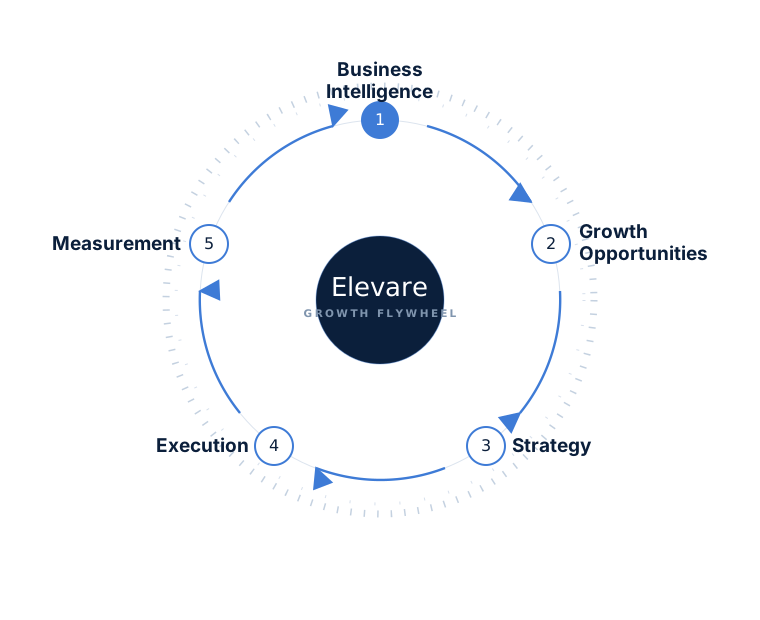
At Elevare we start from a simple belief: growth is rarely missing, it is constrained — and improving anything except the constraint just creates activity. We diagnose against six lenses: market, revenue, operations, technology, intelligence, and leadership. In manufacturing the constraint sits in revenue far more often than owners expect, and this is the clearest case of it there is. The product is good, the capability is real, the demand is arriving. What's missing is the connective tissue between an inbound signal and a fast, owned response. That tissue is a system, and most shops have never built one because the work of running the plant always comes first. In another shop the constraint will sit somewhere else entirely — the discipline is finding it, not assuming it. See the six lenses →
You rarely lose the quote to a better competitor. You lose it to a faster one — and speed is a system, not a personality.
The good news in that reframe is that it's fixable without spending a dollar more on demand. A follow-up system doesn't require a new CRM platform or a rebrand. It requires deciding who owns an incoming RFQ, how fast it gets a first response, what the second touch is, and what happens when the owner is unavailable. Put simply, it's a set of rules and a little automation laid over the tools you already have.
A five-minute audit of your own funnel
You don't need software to find the leak. Walk your last two weeks of inbound and answer honestly:
- When an RFQ arrives, who owns the response — a named person, or whoever notices?
- What's your average time to first reply, measured in hours? Do you even know it?
- If your lead estimator is out for a week, what happens to incoming quotes?
- After a quote goes out and the buyer goes quiet, is there a second touch — and whose job is it?
- Can you say how many RFQs you got last month and how many you responded to? Or only how many you won?
If those answers are fuzzy, you've found the constraint. It isn't your marketing and it isn't your pricing. It's the handoff between interest and response — and it's costing you orders you already earned.
The recommendation this produces
Every recommendation Elevare makes carries the same seven parts, whether it comes from a proposal, a Growth Note, or Command. Here is what this article's finding looks like written to that standard — so you can judge the reasoning rather than take the argument on faith.
RFQs arrive into a shared inbox with no assigned owner, no target response time, and no record of time-to-first-reply. Quoting queues behind production, and a single estimator is the effective bottleneck.
Manufacturing demand is high-intent and time-sensitive; the buyer contacted several suppliers the same afternoon. An unowned RFQ is decided by whoever happens to notice it, which means orders are being lost to sequence rather than to price or capability.
Count of RFQs received against RFQs quoted over a recent period; time from receipt to first reply where it can be reconstructed; the absence of any routing rule or backup when the estimator is unavailable; win rate segmented by response speed where the data supports it.
Name an owner for every inbound channel and set a first-response standard — an acknowledgement with a quote-by date within a defined window, separate from the quote itself. Add one automated safety net so nothing sits unseen, and a named backup for estimator absence. Built on existing tools.
More of the existing RFQ volume converting, with no additional demand spend. Measured on two numbers: percentage of RFQs acknowledged inside the window, and quote-to-order rate on RFQs meeting it versus those that don't.
First, ahead of any lead-generation work. More RFQs into an unowned queue would leak at the same rate — and the comparison in the second metric is what proves or disproves this recommendation.
High on the diagnosis. Unquantified on the gain. Whether an RFQ has an owner is directly observable. The size of the recovery depends on how many unanswered RFQs were winnable, which cannot be known until response time is measured. We would rather say that than quote a number we can't defend.
Catching what you already have
The highest-return growth move for most manufacturers isn't more leads. It's catching the ones already arriving. Assign every RFQ an owner. Set a response-time standard and measure against it. Build one automated safety net so nothing sits unseen. Add a second touch so quotes don't die of silence. None of that is glamorous, and all of it compounds — because every quote you used to leak was demand you'd already paid to create. Close the middle of the funnel, and the same inbound you have today starts turning into orders.