The Elevare Recommendation Standard
One standard governs every recommendation Elevare makes — in a proposal, in a Growth Note, in a meeting, or from Command. Seven parts, always, in the same order. If a recommendation cannot carry all seven, it is not ready to give you. We publish the standard and a complete worked example so you can judge the reasoning before you hire anyone, including us.
Why a standard at all
Most business advice arrives as a conclusion. Someone experienced looks at your company and tells you what to do. The reasoning stays in their head, which means you are not evaluating the recommendation — you are evaluating your confidence in the person.
That is a bad trade for you. It hides the two things you most need to see: what the advice is actually based on, and how sure anyone really is. A recommendation without reasoning is an opinion. The standard exists to make ours checkable, including in the places where it is weak.
It also imposes a discipline on us. Several of these parts are difficult to complete honestly, and a recommendation that cannot complete them is usually a recommendation that was not ready. The standard catches that before it reaches you rather than after.
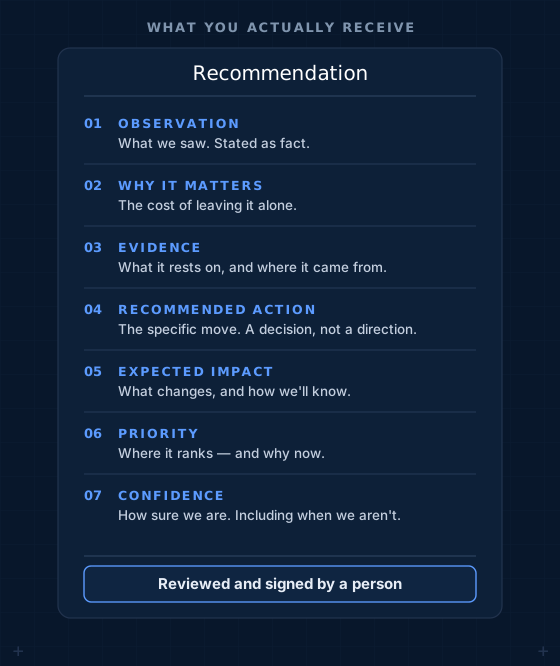
The seven parts
1. Observation
What we saw, stated as fact and free of interpretation.
An observation is something you could verify yourself. It is not a diagnosis and not a judgment. Separating the two is what makes the rest of the recommendation checkable — if you disagree with our conclusion, you can see exactly which observed fact we built it on, and say so.
2. Why it matters
The business consequence, in the terms the business actually runs on.
An observation with no consequence is trivia. This part connects what we saw to money, capacity, risk, or time, and it names which of the six constraint lenses the problem sits on. If we cannot state the consequence plainly, the observation was not worth raising.
3. Evidence
What supports it, including what does not exist.
Evidence is where most advice is thinnest, so we state ours explicitly — the data examined, the period, the method. An absence counts too: when a business has no report joining margin to customer type, the missing report is itself evidence, and often the strongest available.
4. Recommended action
The specific move, scoped and sequenced.
Not a direction, a move. Specific enough to start on Monday, scoped enough to finish, and sequenced against what should not be done yet. The instruction to hold off on a second change is part of the recommendation, not a caveat attached to it.
5. Expected impact
What should change, and how you will know.
Stated as the mechanism and the measure, not as a percentage we cannot support. If we can quantify it honestly we do. If we cannot, we say what to measure so the answer exists after the fact rather than being asserted before it.
6. Priority
Where this sits against everything else, and why.
Priority is a comparison, so it requires the full picture. This part explains what the recommendation goes ahead of and what it waits behind — usually because delay makes it more expensive, or because a later decision depends on the evidence this one produces.
7. Confidence
How sure we are, separated into diagnosis and gain.
The part most advice omits. We split it deliberately: confidence in the diagnosis and confidence in the size of the return are different questions with different answers. High on one and low on the other is a normal, honest position — and stating it is what stops a reasonable recommendation from being oversold.
A complete worked example
Below is a full recommendation written exactly as it would be delivered, for a mid-market manufacturer. It is illustrative rather than drawn from a client engagement — the point is the shape of the reasoning, which you can judge on its own terms.
It is deliberately not a marketing or website recommendation. Those are the ones a growth partner has an incentive to reach for, and reaching for them is precisely the habit this standard is built to interrupt. This one sits on the Intelligence lens, and the recommended action is to build a view rather than to buy anything.
A representative recommendation for a mid-market manufacturer, written exactly as it would be delivered. Deliberately not a marketing or website recommendation — this is what an Intelligence constraint looks like.
The business reports revenue by product line and gross margin at the company level. It cannot report margin by customer segment. Sales incentives are paid on revenue, and the fastest-growing segment is also the most heavily discounted one.
Growth is currently being bought rather than earned. Every incremental dollar of demand is routed toward the segment that returns the least, and because nobody can see it, the pattern strengthens each quarter. This constrains the business more than any lead-generation gap, and no amount of marketing corrects it.
Two years of invoice-level data joined to the customer master; realized price against list by segment; the commission plan; and the observation that no existing report in the business joins margin to customer type. The absence of the report is itself the finding.
Build one segment-margin view from data the business already has, reviewed monthly. Then make one decision with it before changing anything else: which segment gets the next increment of sales capacity. Do not restructure the commission plan yet — a plan changed before the data is trusted gets reversed.
Improved gross margin at flat revenue within two quarters, from reallocation rather than price increases. The durable gain is decision quality: the business gains a number it can steer by, which changes every subsequent capacity and pricing decision.
First, and it should precede any growth spend. Every quarter it waits, more capacity commits to the wrong segment and becomes harder to move. It is also cheap and reversible, which is rare for a change this consequential.
High on the diagnosis. Low on the size of the gain until the data is built. That the business cannot see segment margin is a fact, not an interpretation. How much margin is actually being lost is unknown until the view exists — which is precisely why the first recommendation is to build the view, not to act on an assumed number.
What the standard will not do
It does not make a recommendation correct. Seven well-written parts can still rest on a wrong reading of the business, and no format protects against that. What it does is make the reading visible, so a wrong one can be caught — by you, in the meeting, before money moves.
It also does not remove the person. Command finds opportunities and ranks them; a person reviews the reasoning, tests it against what they know about your business, and puts their name on it before it reaches you. Automation never removes accountability, and nothing arrives unreviewed.
Judge it before you hire us
This is the shape of every recommendation we make. If the example above reads like something you would want in front of you before making a capacity decision, that is the best available indication of what working together looks like. If it does not, you have learned that at no cost, which is also a useful outcome.