We start with the business. Never the service.
The complete reasoning behind every recommendation we make — published in full, before you spend anything.
Growth isn't missing. It's constrained.
So the constraint sits somewhere nobody is looking, and everyone stays busy improving the parts that were already working.
Growth is constrained in one of six places.
This is the instrument we diagnose with. It is deliberately wider than what any single vendor can see — because the constraint is usually in the lens nobody owns.
You're pointed at the wrong demand.
Wrong customers. Weak positioning. Poor differentiation. Not enough real demand for what's being sold. No amount of execution fixes a market constraint.
Demand arrives and doesn't convert.
Lead generation, sales process, CRM, follow-up, pricing, pipeline, conversion. The business earns the opportunity and loses it somewhere between interested and closed.
Delivery costs more than it should.
Manual work, fragmented systems, slow execution, weak reporting, operational complexity. Growth adds friction instead of profit.
The tooling works against the work.
Disconnected software, poor integrations, aging digital infrastructure, low automation. Every system is fine on its own and none of them talk.
Decisions are made without evidence.
Missing information, no measurement, weak prioritization, no visibility. The business can't tell which of its bets are working, so it keeps making all of them.
The company isn't aligned on what matters.
Unclear priorities, decision paralysis, organizational complexity, misalignment. Everyone is executing. Not everyone is executing the same plan.
The questions we ask before we recommend anything.
Seven questions that locate the constraint inside the six lenses. Answers to these decide the work — every recommendation we make traces back to one of them.
- 01 Where does revenue actually come from?
- 02 Where are opportunities being lost?
- 03 Where do customers disengage?
- 04 Which systems are working, and which are quietly slowing the business down?
- 05 What should be automated?
- 06 Where would AI remove real work?
- 07 What produces the highest return on effort?
What we do with the answers.
One engagement is one pass through this sequence. Skipping a step is where waste comes from — most commonly the jump straight from a symptom to a solution.
-
01 OBSERVE
Read the whole business before forming an opinion about any part of it.
-
02 UNDERSTAND
Learn how the business actually makes money, not how the org chart says it does.
-
03 DIAGNOSE
Locate the constraint against the six lenses. Name it plainly, with evidence.
-
04 PRIORITIZE
Rank what to fix by business impact — not by what we happen to be good at.
-
05 EXECUTE
Build and ship the fix. Strategy that isn't implemented produces nothing.
-
06 MEASURE
Establish what moved, and what didn't. Confidence should match evidence.
-
07 LEARN
Feed the result back in. The next diagnosis starts from a sharper picture.
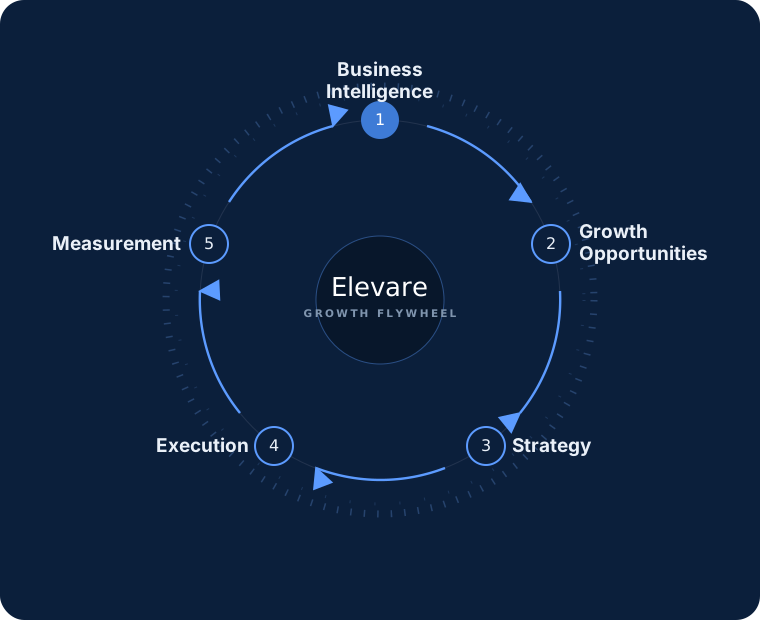
Why the second year is worth more than the first.
Each completed turn leaves the business easier to read than it was before. That is the entire compounding argument — and the reason a partnership outperforms a project.
- 1Business Intelligence. What is actually true about the business right now.
- 2Growth Opportunities. Where the constraint sits, and what removing it is worth.
- 3Strategy. The specific move, chosen over the alternatives, with reasons.
- 4Execution. The fix, built and in production in your business.
- 5Measurement. What moved — which becomes the next turn's intelligence.
Seven convictions that shape every engagement.
Everything else is a mechanism. A website, a CRM, an AI assistant — each one matters only to the degree it moves the business.
We diagnose where growth is being lost before we recommend anything. The problem defines the work, not the other way around.
Being busy creates motion. Understanding creates progress. We exist to improve judgment, not to increase the amount of work in flight.
Complexity is a tax on growth. Every proposal, system, and explanation we produce should get simpler over time, not larger.
You shouldn't admire our software. You should admire the results. Technology has succeeded when you stop noticing it.
Seeing the whole business is the advantage. No one optimizing a single slice can find what's actually capping growth.
The best time to fix a constraint is before it costs you. We would rather flag it early than bill the emergency later.
A plan built for your business, not our invoice.
Every recommendation follows one standard, and we publish it — see the anatomy of an Elevare recommendation.
Want this applied to your business?
A 30-minute First Read — where revenue comes from, where it is constrained, and the highest-return moves. No pitch, no service menu.