ILLUSTRATIVE TEMPLATE — a representative example of a Growth Note. Real Growth Notes are published with client permission.
The quote follow-up leak.
A healthy top of funnel, a leaky middle.
In this representative scenario, the business had no demand problem. Inbound requests came in steadily, the counter and outside sales teams turned them into quotes quickly, and quotes went out the door in volume. On paper, the pipeline looked strong. The gap was quieter and further down: once a quote was sent, nothing owned what happened next. Follow-up depended on whoever remembered — which meant it depended on nothing.
Quotes died in inboxes.
A quote is not a sale — it is a request for a decision. Without a system to carry that request forward, quotes sat in customer inboxes and then in the past. A buyer who was genuinely interested but busy simply went quiet, and no one circled back. The revenue was already earned in every way that mattered except the last one: the ask. Each un-followed quote looked survivable on its own. Together, across a year, they were the single largest source of lost, recoverable revenue in the business.
A follow-up system on tools they already owned.
No new platform, no rip-and-replace. This is a Revenue Systems fix: we built the follow-up motion on the CRM and email tools the company already paid for. Every quote created a tracked obligation with an owner and a clock. Sequenced, personal-feeling follow-ups triggered automatically at set intervals unless a rep intervened, and anything that went cold surfaced on a short daily list instead of disappearing. The work of remembering moved out of people's heads and into the system — where it could not be forgotten.
More quotes turned into orders.
The mechanism is simple and it compounds: when every quote gets a consistent, timely second and third touch, more of the buyers who were always going to buy actually do — and some who would have drifted come back. In this illustrative example, quote-to-order conversion improves by a double-digit margin, with no increase in quote volume and no new headcount. The gain is not from generating more demand; it is from stopping the leak in demand the business had already created.
What this rests on.
Quote volume and quote-to-order rate from the CRM across a trailing year; the count of quotes with no recorded contact after the send date; interviews with sales describing follow-up as "whoever remembers."
First, ahead of any demand generation. The fix works on revenue the business has already paid to create, requires no new spend, and is reversible — which is a rare combination for a change this consequential.
Illustrative. The mechanism is well established and the diagnosis pattern is one we observe repeatedly. The improvement described here is modelled from those patterns, not measured from a specific client engagement. When a real Growth Note publishes, this line will state a measured result or say plainly that it can't.
The result sharpens the next move.
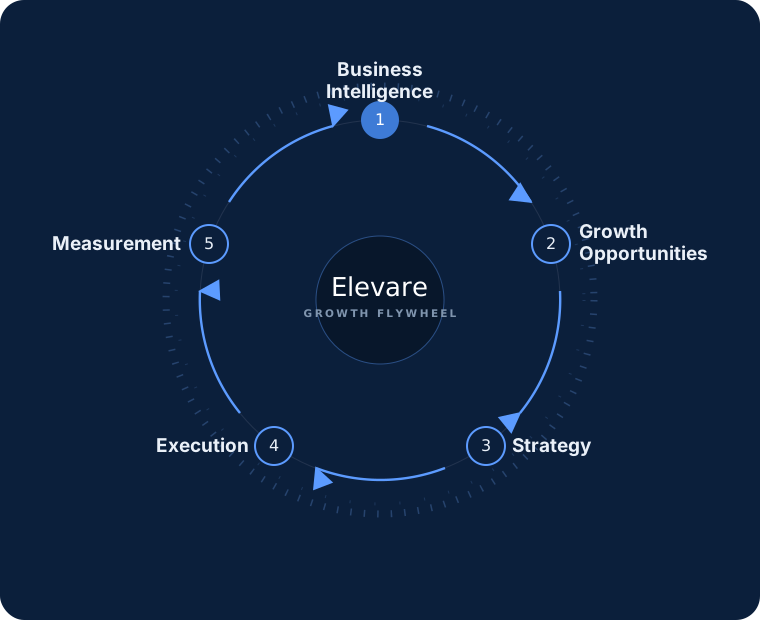
A closed leak is not the end of the engagement — it is a new input. With follow-up now measured, Command can see which quote types, reps, and intervals convert best, and where the next friction sits: response time, pricing clarity, the handoff between quote and order. Measurement feeds the intelligence, the intelligence surfaces the next opportunity, and the next turn of the flywheel is easier than the last. That is the point of a Growth Note — not to celebrate one fix, but to show the loop that keeps producing them.