Continuous business intelligence.
The intelligence layer behind every recommendation we make. It is how Elevare sees — and the reason advice arrives already reasoned, already ranked, and already checked against the whole business.
An intelligence layer, not an inbox of tickets.
What it can see changes depending on where we are in the relationship. That distinction matters, so we state it plainly rather than implying more than is true.
Before we work together
Command reads what is observable from outside: your digital presence, market signals, and how the business is positioned to adopt technology. It is enough to arrive at the first conversation with a hypothesis instead of a questionnaire — and honest enough to admit that a hypothesis is all it is.
Once we're inside
Command reads far more: revenue systems, operations, customer signals, your documentation, and the history of what has already been tried and why. And it remembers — decisions, context, results. That memory is why the advice sharpens every quarter instead of resetting with every project.
What Command is — and what it isn't.
Command is
- A continuous reading of the whole business, once we are inside it
- An engine that detects and ranks growth opportunities
- The reason our recommendations are proactive
- Our competitive advantage as a firm
- Intelligence that compounds the longer we work together
Command is not
- A product you buy or a seat you license
- A dashboard you're asked to log into and manage
- Another tool added to your stack
- AI for its own sake
- Something we use to sell you more services
How Command turns signal into strategy.
Company inputs flow into an opportunity engine, which resolves to a single highest-impact move and the playbook to execute it.
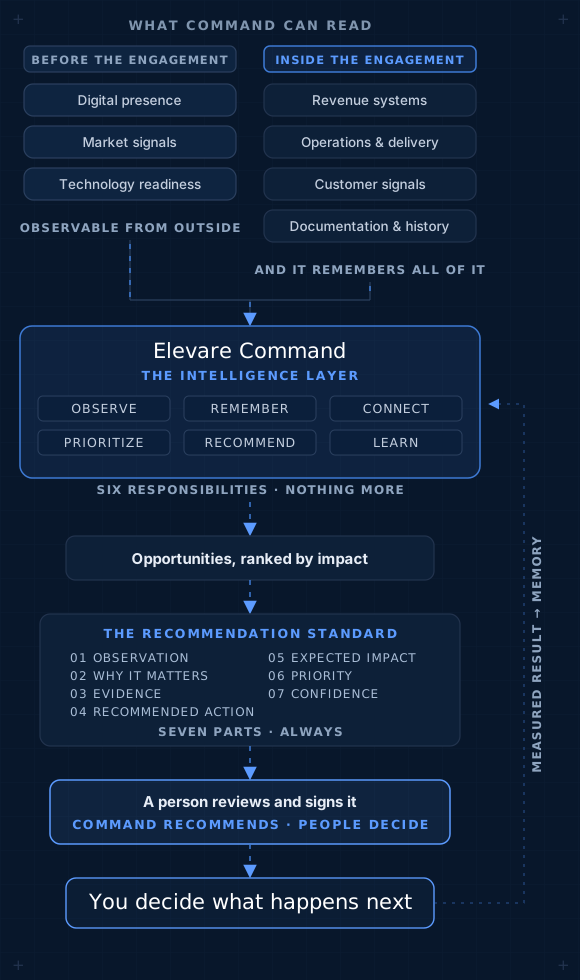
Signal in. Prioritized, executable strategy out. Continuously.
Six responsibilities. Nothing more, nothing less.
Command is not a loop of its own. It is what powers the Growth Flywheel — and these are the only six things it is responsible for. Anything outside this list is scope creep, and we treat it as such.
Notice what people miss.
It watches the business continuously for new signals, risks, and patterns. Observation is passive by design — it creates awareness, not work.
Hold what the business forgets.
People forget. Organizations drift. Knowledge walks out the door. Command keeps the decisions, the context, the lessons, and the reasons — so nothing important depends on one person's memory.
Find what sits between systems.
Most opportunities aren't inside marketing or sales or operations. They're in the gaps between them. The value is usually in the relationship, not the individual fact.
Reduce noise, not add to it.
Everything gets ranked by business impact. If everything is important, nothing is — so Command's job is to tell you what to ignore as much as what to act on.
Never without reasoning.
Every recommendation carries its observation, evidence, expected impact, priority, and confidence. A recommendation without reasoning is an opinion. We deliver judgment.
Improve from what actually happened.
Results feed back in. Recommendations that worked strengthen future judgment; ones that didn't get reviewed and captured. Learning is evidence-based and traceable, or it isn't learning.
Command powers the Flywheel. It is not the Flywheel.
What a recommendation from us looks like.
One standard governs every recommendation Elevare makes — in a proposal, in a Growth Note, in a meeting, or from Command. Seven parts, always. If a recommendation can't carry all seven, it isn't ready to give you.
What we saw. Stated as fact, not interpretation.
The business consequence of leaving it alone.
What supports the observation, and where it came from.
The specific move. Not a direction — a decision.
What should change, and how we'll know it did.
Where it ranks — and why it matters now rather than later.
How sure we are, stated honestly, including when we aren't.
This is the shape of every recommendation we make. Judge it before you hire us.
Command recommends. People decide.
Intelligence improves judgment. It does not replace responsibility, and it never carries the relationship.
Vision, relationships, ethics, and final decisions stay with humans. That boundary is written into how we operate, not decided case by case. If Command cannot explain a recommendation, it does not make one.
Why it compounds.
A vendor relationship restarts at zero every project. This one doesn't — and that difference is the entire commercial argument for a partner over a supplier.
It gets smarter the longer we work together.
Every result feeds back into the intelligence — what worked, what didn't, and why. The Flywheel turns, and the next diagnosis starts from a sharper picture than the last one did. The second year of a relationship is worth more than the first because the intelligence behind it is.
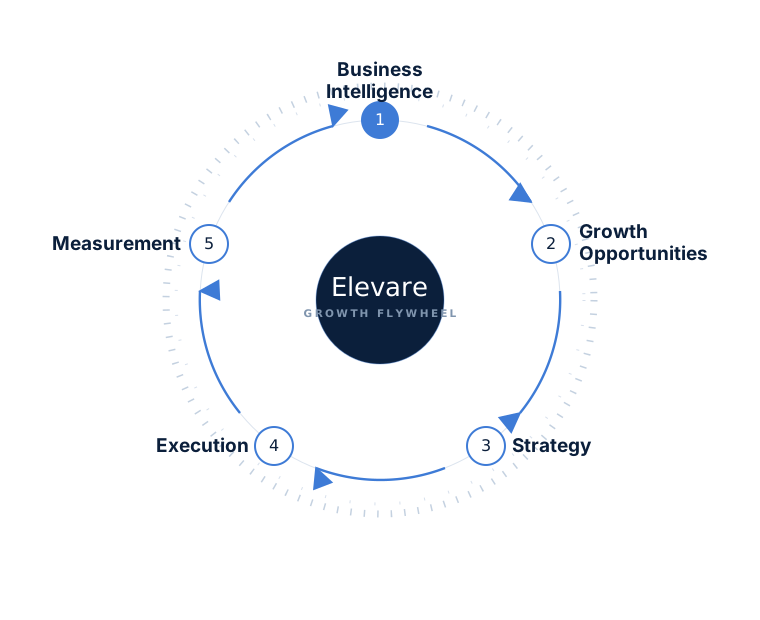
Command discovers. Elevare interprets and executes. You experience continuous improvement.
That's the whole model. Command is not the product and never will be. It is the reason a partnership with Elevare is different from hiring another vendor — and the reason a recommendation reaches you already reasoned, already ranked, and signed by a person who is accountable for it.
See what Command surfaces for your business.
A 30-minute First Read, reasoned from the same intelligence that powers every engagement. No pitch, no obligation.